



This is Part 1 of a two-part article.
Deposit flows aren’t just a reflection of customer preferences; they also drive profitability, financial stability and lending capacity. When deposits move, they can affect balance sheet growth, increase credit availability and reshape the competitive landscape. It’s therefore notable that over the past five years, historic volatility has redistributed deposits among banks, with the smallest gaining the largest share.
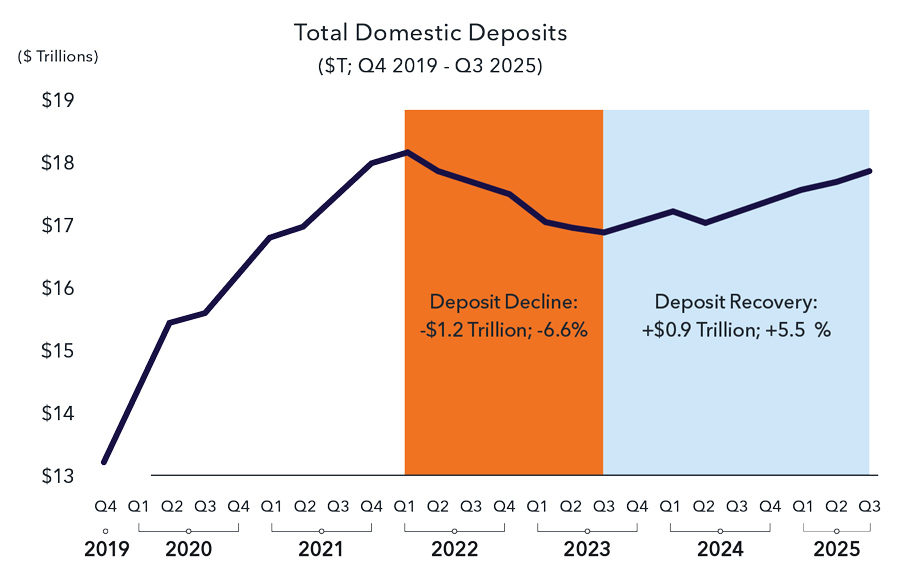
Deposit Growth Has Reaccelerated to a More Normalized Growth Path …
As the accompanying chart shows, total domestic deposits surged during the pandemic and then declined sharply during the Fed’s tightening cycle. In late 2024, deposits began flowing back into banks as the Fed began softening its interest rate policy. By Q2 2025, after 100 basis points of cuts to the fed funds rate, domestic deposits had grown by roughly $900 billion.
… And Is Now Tracking Historical Growth Periods
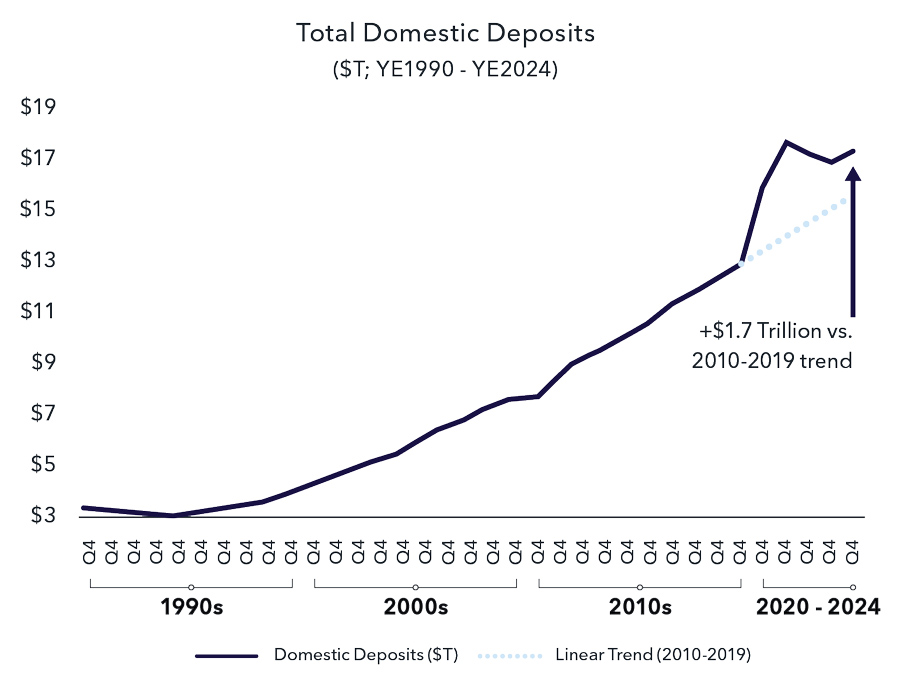
This recovery has followed a stable trajectory, with a compound annual growth rate (CAGR) of approximately 3%, far more sustainable than the 16% CAGR during the pandemic and closer to the 5% CAGR seen before 2020. The aggregate deposit level has settled at $1.7 trillion above the pre-pandemic trend line.
Punching Above Their Weight: Community Banks Outperformed Their Larger Peers
While all bank size groups have grown deposits since the Q3 2023 bottom, community banks have gained the most relative to their size on a merger-adjusted basis. Learn why in Part 2.
Methodology
This analysis uses data from bank call reports covering Q4 2002 through Q2 2025. Deposits were attributed to each bank’s FDIC-defined ultimate certification number to account for mergers and acquisitions. Bank size was determined by each institution’s total assets as of Q2 2025.
About IntraFi
Since its founding over 20 years ago, IntraFi has been chosen by over 3,000 financial institutions. IntraFi’s deposit network is the largest of its kind, and its tested, trusted services help its network members acquire high-value relationships, fund more loans and seamlessly manage liquidity needs. IntraFi invented reciprocal deposits and is the No. 1 provider of deposit placement solutions, offering the largest per-depositor, per-bank capacity.